






The Evolution of School Leavers Keepsakes: From Yearbooks to Personalised Memories
How school leavers in the UK choose to remember their final year has shifted quite dramatically over the past decade or so. The emotional weight of leaving school hasn't changed, that bittersweet mix of excitement and nostalgia is as strong as ever, but the ways young people hold onto those memories certainly have. What once meant a yearbook and a signed shirt now looks quite different.
The Rise of Personalised Group Items
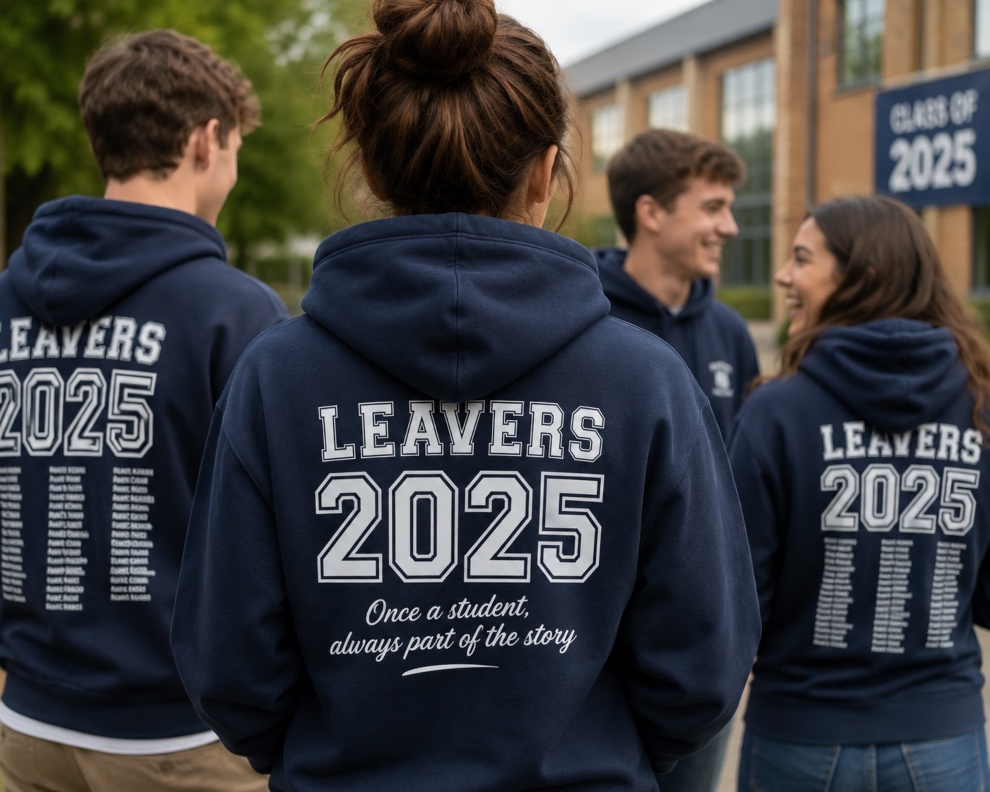
Perhaps the most visible sign of this shift is the growing popularity of personalised group items. School leavers' hoodies are now a familiar fixture of the modern leaving experience, designed collaboratively by students and packed with names, nicknames, school logos and nods to shared in-jokes. What makes them interesting is that they're not passive objects, they're actually worn. They become part of everyday life during that final year and often long after, which sets them apart from keepsakes that simply sit in a drawer.
What Came Before
For previous generations, yearbooks were the thing. Class photos, a message from your form tutor, a few pages for friends to scribble in, they were simple but meaningful. Yearbooks haven't disappeared entirely, but their role has quietly shrunk as students have gravitated towards more immediate, interactive ways of marking the moment. That's not a criticism of yearbooks; it simply reflects how much the wider culture around documentation and communication has changed.
Autograph shirts and signed school ties were also a big part of the leavers tradition for a long time. Collecting messages from classmates and teachers created a kind of physical map of your social world at that particular point in time. Some schools still do this, which is lovely, but these traditions have largely been supplemented by alternatives that feel more personal and more deliberately designed.
Identity and What It Means to Leave
One reason personalised keepsakes have taken off is that young people today seem more attuned to questions of identity during their school years. The final year especially tends to be a time of figuring out who you are, both as an individual and as part of a wider group. That awareness naturally shapes what kind of memorabilia feels meaningful. Generic, off-the-shelf items don't quite cut it anymore. Students want things that reflect their actual personalities, their humour, their friendships. That's a reasonable thing to want.
The Role of Digital Technology
Smartphones and social media have completely changed how memories are captured in the first place. These days, moments get documented almost as they happen, a quick photo in the corridor, a clip from the leavers assembly, a group selfie on the last day. Memory-making has become continuous rather than something that happens at the end of the year in one big organised effort.
And yet, despite all of that, physical keepsakes haven't gone away. If anything, there's been a quiet reassertion of their value. A photo on your phone is easy to scroll past; a hoodie you wore during your final year of school carries a different kind of weight. Physical objects anchor memories in a way that digital content often can't. They give you something to hold, something that exists in the world rather than on a screen.
Blending the Old and the New
What's emerged is really a blend of both approaches. Digital and physical memory-making aren't competing with each other so much as coexisting. Photos get shared on social media the same week that a group hoodie arrives in the post. A WhatsApp group set up for the leavers sits alongside a printed group photograph hung on someone's bedroom wall. These different formats layer on top of each other to create a fuller, richer record of that time.
Students Taking the Lead
Another notable change is how involved students now are in actually creating their keepsakes. It used to be that leavers items were largely decided by schools or suppliers, with students having little say in what the final product looked like. That's changed considerably. Today, students often drive the whole process, pitching ideas for designs, debating slogans, arguing over colour schemes. The result feels genuinely representative of the year group rather than something handed down to them.
That sense of ownership matters a great deal. When you've had a hand in creating something, it means more. The hoodie isn't just a reminder that you attended a particular school; it's a symbol of the specific friendships, decisions and shared experiences that made that year what it was.
How Schools Have Responded
Schools themselves have largely got on board with this shift. Many now actively support students in organising personalised leavers items and encourage them to take ownership of how their final year is commemorated. There's a growing recognition that the leavers period isn't just about exams and results; it's a significant emotional and social milestone that deserves to be marked properly.
The Purpose Hasn't Really Changed
For all the ways the landscape has shifted, the underlying reason for keepsakes remains exactly the same: to hold onto a moment that matters. Whether that's through a handwritten note in a yearbook, a photo saved to your camera roll or a hoodie covered in nicknames, the impulse is identical. You want something that lets you look back and remember how things felt at a particular point in your life.
What has changed is the range of options available and the degree to which those options reflect the people using them. Today's keepsakes tend to stay relevant for longer, too. Rather than being boxed up and forgotten, wearable items in particular continue to show up at college, university and beyond, keeping the connection to that time alive in a quite ordinary, everyday way.
The story of school leavers keepsakes is, in the end, a story about how young people make meaning. The tools and formats have evolved, but the desire to hold onto something real hasn't gone anywhere.