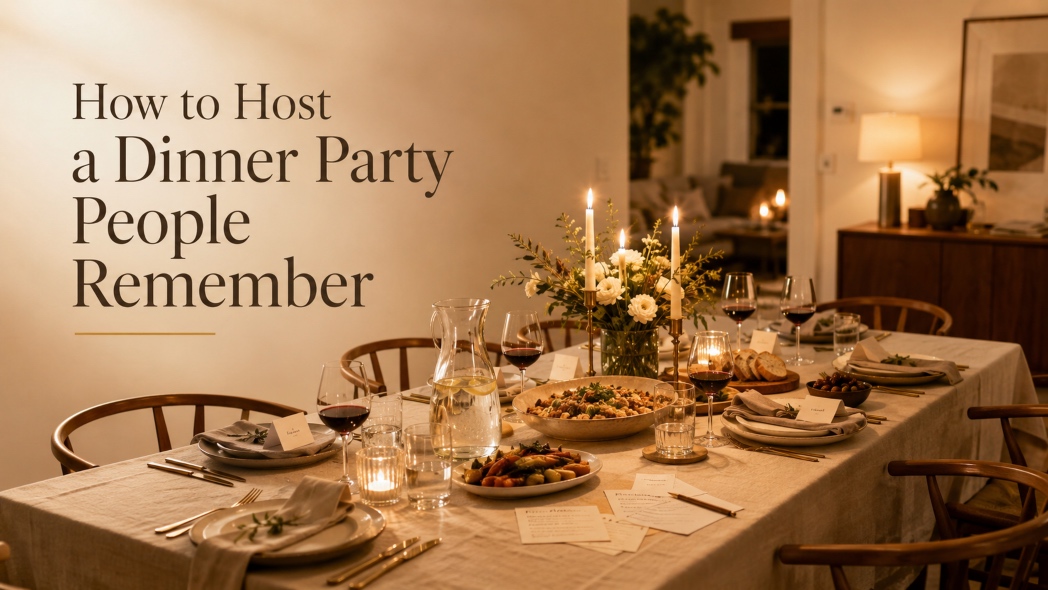






How to Host a Dinner Party People Remember
An epic dinner party is decided before anyone rings the doorbell. Invite six people, cook one dish that needs the oven at the last minute, finish most of the food the day before, buy half a bottle of wine per guest, and decide who sits where. If you plan to introduce an after-dinner game, choose something simple in advance; gamerules is a useful place to check the instructions and make sure you can explain them without interrupting the evening. After that, the night largely runs itself.
The failure mode is always the same. A host picks four ambitious recipes, spends the entire night at the stove with their back to the room, and joins the table around dessert looking wrung out. Guests notice. They eat well and leave early.
How many people should you invite?
Six. A table of six sustains one conversation that everyone can hear and join, which is the thing people remember afterward. At eight the table starts breaking into two halves, and Real Simple's long-standing guidance is to cap a single table at eight guests for exactly that reason.
That does not make ten mistakes. It means you should plan for the split instead of fighting it, either by seating two tables and moving between them, or by borrowing the Jefferson dinner format: 8 to 14 guests, one table, one topic announced in advance, side conversations gently discouraged. Foundations and universities use it because it reliably produces one real discussion instead of six polite ones.
If this is your first time hosting, start at four. You will learn more about your own timing from four guests than from twelve.
What should you cook?
One dish that needs heat at the last minute. Everything else should be cold, at room temperature, or reheatable without judgment calls.
Braises, stews, casseroles, and slow-cooked ragùs are the whole category worth building around, because they improve after a night in the fridge. A roast chicken works. A rack of lamb and a risotto in the same menu do not, since both demand your attention in the final ten minutes and you only have one set of hands.
Buy the bread. Make the dessert the day before, and pick one that is supposed to sit: panna cotta, tiramisu, pots de crème, a tart. Wash and dry salad leaves in advance, mix the dressing separately, and combine them ninety seconds before you sit down.
Ask about allergies and dietary restrictions when you invite people, not the night before. A vegetarian at a table where the only main is beef will say it is fine, and it will not be.
When should you do the prep?
Work backwards from the time you plan to serve, and split the work across three days.
Three days out is for sauces, dressings, marinades, and anything you brine or season in advance. The day before is for the master prep list: sit down with every recipe and break it into timed tasks, checking oven temperatures against each other and counting how many burners you need at once. Two dishes that want different oven temperatures at 7pm is the classic unforced error.
The morning of is mise en place. Chop, measure, portion. Set the table, cut the flowers, and place the candles now, because tall candles and layered tea lights take longer than you think and nobody wants to be arranging a centerpiece at 6:45.
Build in buffer. Never schedule a dish to finish at the exact minute you plan to serve it, and empty the dishwasher before the first guest arrives so you can load it quietly during dessert.
How much wine and water do you need?
For a sit-down meal, plan half a bottle per person, which works out to roughly three glasses each. A standard 750ml bottle pours five glasses at five ounces, so six guests means three bottles as the baseline. Buy five.
For a longer, looser evening where people arrive at seven and leave at one, event planners use a different rule: one drink per guest per hour. Scale up accordingly, and split your buying between one dry white and one dry red so people can choose.
Water gets forgotten and it should not. Guests get through roughly twelve ounces every half hour to hour, so put a full carafe on the table before anyone sits down rather than refilling from the tap all night. Have one genuinely good non-alcoholic option too, because a guest who is not drinking should not be handed a glass of tap water while everyone else gets stemware.
Where should everyone sit?
Decide in advance if you have more than six guests, and use place cards above six. Below that, letting people sit where they land works fine.
Split couples. Seated together they talk to each other and the table loses two people. Break up friend clusters for the same reason, because the group that arrived together will otherwise colonize one end and everyone else will feel like a plus-one.
Then place by personality rather than by aesthetics. Put each loud talker between two listeners and each quiet guest between two warm openers. If you are cooking, take the seat nearest the kitchen so you can stand up without the whole table pausing. Ina Garten has made the point that an unobstructed path to the kitchen matters more for a host who cooks than any head-of-table tradition.
Which games are worth playing, and when?
After the main course and before dessert, when plates are pushed back and the conversation has hit its first natural lull. Games work at that moment and almost nowhere else. Too early and you interrupt people who are still getting comfortable; too late and you are reviving something that has already ended.
Kiss Marry Kill is the most reliable of the forced-choice games, and it needs no props. One person names three people or characters and everyone else assigns one verb to each, with no skipping and no overlaps, then defends the choices out loud.
It has collected an absurd number of regional names over the decades: Bang Marry Kill and Bed Wed Dead in the United States, Snog Marry Avoid in Britain, which BBC Three turned into a series that ran from 2008 to 2013, and a cruder original phrasing that most hosts trade down from. The game has also been criticized as tasteless and juvenile, and it can absolutely be both, which is almost entirely a function of the names you feed it.
Two rules solve that. Never use anyone sitting at the table, and never use anyone's ex. Stick to fictional characters, historical figures, cartoon animals, and household appliances, and the whole thing stays funny instead of turning into a room-clearing moment somebody thinks about in the car. If your group skews mixed-age or professional, the softer variants run on the same engine with less heat: Kiss Marry Avoid, Hug Date Dump, or Hire Fire Promote. Give each person 30 seconds to justify a choice, run two or three rounds, and stop while people still want another one.
The same forced-choice logic drives Would You Rather, Two Truths and a Lie, and Never Have I Ever, all of which need nothing but a table. If you want something with more structure, the Name Game works well with sticky notes on foreheads and yes-or-no questions, and social deduction games like Mafia or Werewolf reward a group who think they already know each other. A murder mystery spread across courses is the maximalist option, and it needs planning, character assignments, and guests who agreed to it in advance.
What do you do when the energy dips after dessert?
Change rooms. Moving to the living room for coffee or a final glass physically rearranges the group, breaks up the pairs who have been talking for two hours, and resets a table that has gone quiet without anyone having to name the problem.
This is also the moment to run the dishwasher you emptied earlier. Do it while you are pouring coffee and the end of the night becomes a conversation rather than a cleanup.
You will know it worked by one measure: people stay later than they planned to. Nobody has ever left a dinner party early because the plating was imperfect.
What is the one rule you never break at your own table?
Gallery